
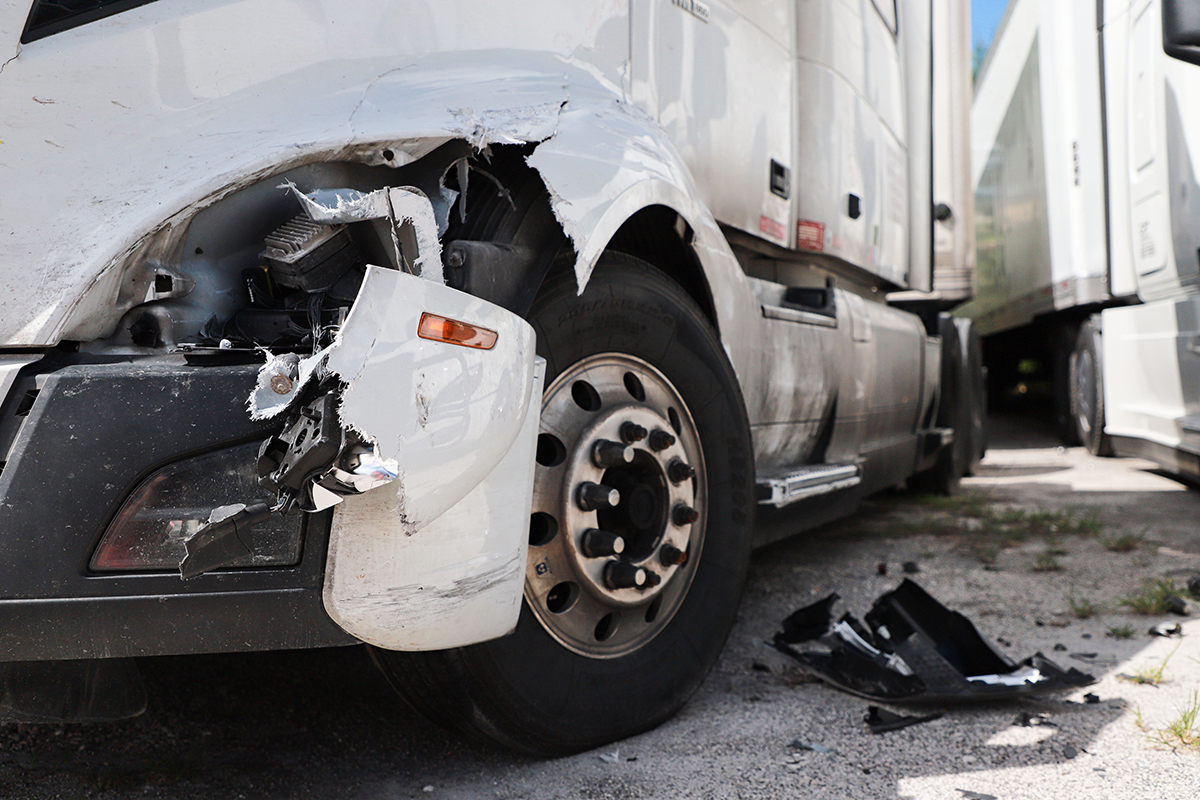
Large commercial trucks — tractor-trailers, box trucks, tankers, and other vehicles over 10,000 pounds — are a constant presence on Hudson Valley roads. I-84, I-87, and US-9W carry heavy freight traffic through Dutchess, Orange, and Ulster counties every day. When these vehicles crash, the weight disparity between a loaded truck and a passenger car means occupants of the smaller vehicle absorb the worst of the impact.
According to data from the New York State Department of Transportation’s Institute for Traffic Safety Management and Research (ITSMR), there were 1,265 large-truck crashes across Dutchess, Orange, and Ulster counties in 2024, resulting in 12 fatalities and 289 injuries. This page breaks down those numbers by county, examines the leading causes, and explains the legal options available to crash victims.
If you or a family member was hurt in a truck accident anywhere in the Hudson Valley, our team of experienced truck accident injury lawyers can help you understand your rights and pursue full compensation.
Trucking Crash Totals by County
Orange County recorded the most large-truck crashes of any county in the region in 2024, accounting for more than half of all incidents. This concentration reflects the heavy freight corridor along I-84 and I-87, which converge in Orange County near Newburgh and carry truck traffic between the Port of New York, Pennsylvania, and New England.
| County | Fatal | Injury | Property Damage | Total | % of Region |
| Dutchess | 4 | 70 | 272 | 346 | 27.4% |
| Orange | 6 | 104 | 560 | 670 | 53.0% |
| Ulster | 1 | 36 | 212 | 249 | 19.7% |
| Three-County Total | 11 | 210 | 1,044 | 1,265 | 100% |
Source: ITSMR / NYS DOT, 2024 data. Crash types are mutually exclusive: Fatal > Personal Injury > Property Damage.
2025 preliminary data (subject to revision):
| County | Fatal | Injury | Property Damage | Total | % of Region |
| Dutchess | 0 | 40 | 196 | 236 | 25.8% |
| Orange | 1 | 95 | 396 | 492 | 53.9% |
| Ulster | 1 | 24 | 160 | 185 | 20.3% |
| Three-County Total | 2 | 159 | 752 | 913 | 100% |
Source: ITSMR / NYS DOT, 2025 preliminary data. Yellow highlighting indicates figures that may be revised as final reports are processed.
Injury Severity in Hudson Valley Truck Crashes
Truck crashes produce disproportionately serious injuries compared to other motor vehicle collisions. The sheer mass of a commercial truck, which is often 20 to 30 times heavier than a passenger car, means that even moderate-speed impacts can cause catastrophic harm. In 2024, the severity breakdown across the three counties was:
| County | Fatal (K) | Serious (A) | Moderate (B) | Minor (C) | Unk | PDO (O) |
| Dutchess | 4 | 9 | 13 | 45 | 2 | 272 |
| Orange | 6 | 18 | 21 | 62 | 2 | 556 |
| Ulster | 1 | 5 | 7 | 24 | 0 | 210 |
| Total | 11 | 32 | 41 | 131 | 4 | 1,038 |
In total, 301 people were killed or injured in large-truck crashes across the region in 2024. Of those, 12 were killed and 37 suffered serious (incapacitating) injuries. Nine pedestrians were among the injured, which stands as a reminder that truck crashes affect more than just the occupants of other vehicles.
Who Bears the Brunt: Truck Drivers vs. Other Road Users
One of the most important findings in the ITSMR data is the stark difference in outcomes between truck drivers and the people in the vehicles they collide with. Of the 224 drivers killed or injured in large-truck crashes in 2024:
| County | Truck Drivers K/I | Non-Truck Drivers K/I | % Non-Truck |
| Dutchess | 17 | 58 | 77.3% |
| Orange | 33 | 75 | 69.4% |
| Ulster | 15 | 26 | 63.4% |
| Total | 65 | 159 | 71.0% |
More than 70% of drivers who were killed or injured were in the non-truck vehicle. Among drivers who died, the disparity was even more pronounced: 7 of the 9 driver fatalities (78%) were non-truck drivers. This pattern is consistent with federal crash data and underscores why truck accident injury claims tend to involve severe, life-altering harm — broken bones, spinal cord injuries, traumatic brain injuries, and wrongful death.
If you were the driver or passenger in a car, SUV, or motorcycle struck by a commercial truck, you likely suffered injuries far more serious than the truck operator.
Top Causes of Trucking Accidents in the Hudson Valley
Understanding why truck crashes happen is critical both for public safety and for building strong legal claims. The ITSMR data categorizes contributing factors into human, vehicular, and environmental causes. A single crash may involve multiple factors.
Human Factors
Human error was by far the most common contributor. The leading human factors in 2024 truck crashes across the three counties were:
| Contributing Factor | All Crashes | Injury Crashes | Fatal Crashes | Fatal + Injury |
| Passing/Lane Changing | 404 | 52 | 6 | 58 |
| Driver Inattention/Distraction | 167 | 22 | 3 | 25 |
| Following Too Closely | 159 | 49 | 1 | 50 |
| Failure to Yield Right-of-Way | 146 | 43 | 2 | 45 |
| Unsafe Speed | 113 | 42 | 0 | 42 |
| Backing Unsafely | 99 | 6 | 1 | 7 |
| Turning Improperly | 87 | 10 | 0 | 10 |
| Fatigued/Drowsy | 14 | 8 | 0 | 8 |
| Fell Asleep | 13 | 5 | 0 | 5 |
Improper passing and lane changing alone accounted for 404 crashes — nearly a third of all truck collisions in the region. Six of those crashes were fatal. This factor is especially dangerous with large trucks because of significant blind spots along the sides and rear of the vehicle.
Driver fatigue is worth particular attention. While the raw numbers (27 crashes coded as fatigued/drowsy or fell asleep) may seem modest, these crashes produced injuries at a much higher rate — 13 of those 27 crashes (48%) resulted in personal injury, compared to the overall injury rate of 17% for all truck crashes. Federal Hours of Service regulations exist specifically to address this risk, and violations of those rules can form the basis of a negligence claim against a trucking company.
Vehicular and Environmental Factors
Mechanical and environmental issues also played a role. The ITSMR data recorded 69 crashes involving oversized vehicles, 17 involving defective brakes, and 12 involving tire failures. On the environmental side, 57 crashes involved obstructed views and 56 involved slippery pavement.
Brake defects and tire failures are significant from a legal standpoint because federal motor carrier safety regulations (49 CFR Parts 393 and 396) require trucking companies to maintain their vehicles and conduct pre-trip inspections. When a crash results from a maintenance failure, the trucking company may be liable.
County-by-County Breakdown
Orange County: More Than Half of Regional Truck Crashes
Orange County recorded 670 large-truck crashes in 2024 — 53% of the three-county total. Six of those crashes were fatal, and 104 resulted in personal injuries. The county’s position at the junction of I-84 and I-87 makes it one of the busiest freight corridors in the Hudson Valley. The Newburgh truck accident lawyers at Mainetti & Mainetti represent crash victims throughout Orange County.
Top human factors in Orange County truck crashes: improper passing/lane changing (237), following too closely (83), failure to yield (83), driver inattention (69), and unsafe speed (60).
Dutchess County: Second-Highest Crash Volume
Dutchess County recorded 346 large-truck crashes in 2024, with 4 fatalities and 70 injury crashes. Truck traffic in Dutchess County is concentrated along I-84 (which crosses the county east-west), US-9, and Route 55. Our Poughkeepsie truck accident attorneys handle cases originating throughout the county.
Top human factors in Dutchess County: improper passing/lane changing (112), following too closely (53), driver inattention (49), failure to yield (38), and unsafe speed (38).
Ulster County: Lower Volume, Serious Outcomes
Ulster County had the fewest truck crashes at 249, but the data still reflects serious consequences — 1 fatality and 36 injury crashes. I-87 (the New York State Thruway) carries significant truck traffic through the county, particularly between Kingston and Saugerties. Our Kingston office serves truck accident victims throughout Ulster County.
Top human factors in Ulster County: improper passing/lane changing (55), driver inattention (49), failure to yield (25), following too closely (23), and backing unsafely (21).
Legal Options After a Truck Accident in New York
Truck accident cases are more complex than typical car accident claims for several reasons. Multiple parties may share liability — the truck driver, the trucking company, a cargo loader, or a maintenance contractor. Federal regulations (FMCSA Hours of Service rules, weight limits, inspection requirements) create additional standards of care that can support a negligence claim.
Under New York’s comparative negligence law (CPLR 1411), you can recover damages even if you were partially at fault. Your compensation is reduced by your percentage of fault but is not eliminated. This is particularly relevant in truck crash cases where the trucking company’s insurer may try to shift blame to the other driver.
Key factors that strengthen truck accident claims include:
- Hours of Service violations: Electronic logging device (ELD) records can show whether the driver exceeded federal driving-hour limits, which is especially relevant given the fatigue-related crash data above.
- Maintenance failures: Brake defects, tire blowouts, and other mechanical issues may indicate violations of 49 CFR Parts 393 and 396.
- Overloaded or improperly secured cargo: Trucks that exceed weight limits or carry unsecured loads are harder to control and take longer to stop.
- Negligent hiring and supervision: Trucking companies can be held liable for putting unqualified or poorly trained drivers on the road.
New York’s statute of limitations for personal injury is three years from the date of the crash, and two years for wrongful death (measured from the date of death). However, evidence in truck cases — ELD data, dispatch records, maintenance logs — can be destroyed or overwritten quickly. Acting promptly gives your attorney the best chance of preserving critical evidence.
Frequently Asked Questions
There were 1,265 large-truck crashes across Dutchess, Orange, and Ulster counties in 2024, according to ITSMR data from the NYS DOT. That works out to roughly 3.5 truck crashes per day across the three-county region. Orange County alone accounted for 670 of those crashes.
Orange County recorded the most large-truck crashes in both 2024 (670 crashes, 53% of the regional total) and in 2025 preliminary data (492 crashes, 54%). The concentration of I-84 and I-87 freight traffic through Orange County drives these numbers.
Improper passing and lane changing was the number-one human factor in 2024, cited in 404 truck crashes across the three counties. Six of those crashes were fatal. Driver inattention/distraction (167 crashes), following too closely (159), and failure to yield right-of-way (146) were the next most common causes.
The occupants of the non-truck vehicle bear the greatest risk. In 2024, 71% of drivers killed or injured in large-truck crashes in the Hudson Valley were in the other vehicle — not the truck. Among driver fatalities specifically, 78% were non-truck drivers.
Yes. Under the legal doctrine of respondeat superior, trucking companies are generally liable for crashes caused by their drivers acting within the scope of employment. Additional claims may arise from negligent hiring, inadequate training, failure to maintain the vehicle, or violations of Federal Motor Carrier Safety Administration regulations. An experienced truck accident attorney can identify all potentially liable parties.
New York’s statute of limitations is three years from the date of the crash for personal injury claims and two years from the date of death for wrongful death claims. However, because truck accident evidence — electronic logging device data, dispatch records, maintenance logs, and black box data — can be destroyed or overwritten quickly, contacting an attorney as soon as possible after the crash is strongly recommended.